
Barcelona offers a convenient and efficient transportation system, making it easy for travelers to navigate the city. In this chapter, we’ll explore the various modes of transportation available, ticketing options, and essential tips for getting around Barcelona.
Buses:
- Overview: Barcelona’s bus network complements the metro system, with extensive routes covering the city and surrounding areas. Buses are especially useful for reaching destinations not directly served by the metro.
- How to Get There: Bus stops are found throughout the city, and the TMB (Transports Metropolitans de Barcelona) website provides route maps and schedules.
- Suggestions/Tips: Buses typically run from early morning to late at night, but night buses (Nitbus) operate after regular service hours.
Trams:
- Overview: Trams offer a convenient mode of transportation along specific routes in Barcelona, connecting various neighborhoods.
- How to Get There: Tram stops are marked with clear signage, and trams run on dedicated tracks, so they are easy to identify.
- Suggestions/Tips: Trams are an excellent option for reaching destinations like the beachfront and Forum area.
Metro:
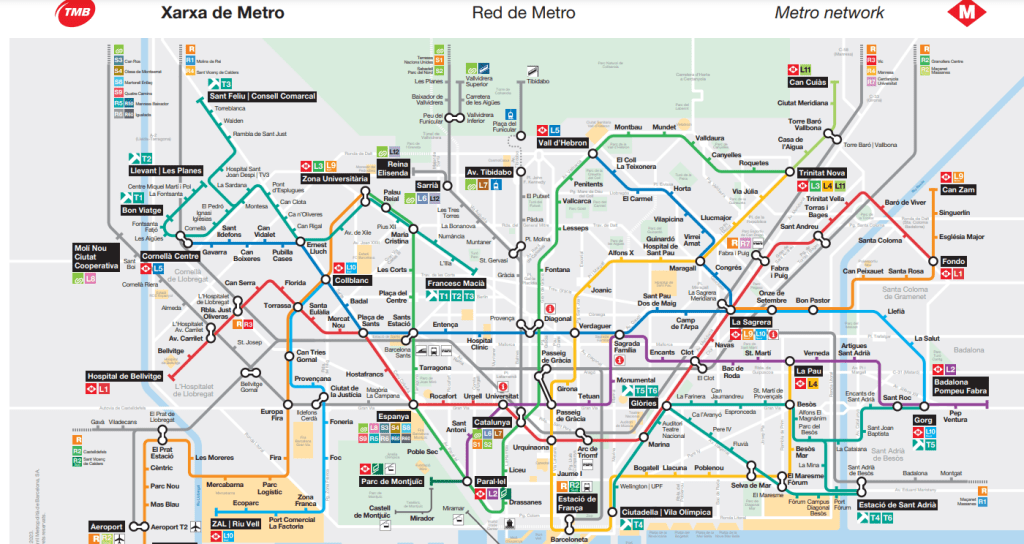
- Overview: Barcelona’s metro system is well-connected and efficient, with several color-coded lines serving the city center and suburbs.
- How to Get There: Metro stations are numerous, and maps are readily available at stations and online.
The metro system consists of several color-coded lines (L1, L2, L3, L4, L5, L9, L10, and L11) that connect the city’s major neighborhoods, attractions, and transport hubs. Metro stations are well-marked and feature prominent signage, making them easy to identify. Stations are equipped with ticket machines, information counters, and digital displays showing train schedules.
Ticket Options:
- Single Ticket (Billete Sencillo): Allows one journey on the metro. Tickets can be purchased at metro stations.
- T-Casual: A multi-ride card that provides ten journeys on the metro, buses, or trams at a discounted rate.
- T-10: A multi-ride card that offers ten journeys on the metro, buses, or trams. It is shareable, meaning multiple travelers can use the same card.
- Hola Barcelona Card: Provides unlimited rides on public transport for consecutive days. It’s suitable for tourists staying for an extended period.
Taxis:
- Overview: Taxis are widely available in Barcelona and can be hailed on the street or booked in advance. They are easily recognized by their yellow and black color.
- How to Get There: Look for designated taxi ranks throughout the city or flag down an available taxi.
- Suggestions/Tips: Taxis are a convenient option for short trips or when traveling with heavy luggage.
Biking:
- Overview: Barcelona is a bike-friendly city, with dedicated bike lanes and rental services. Biking is a fantastic way to explore the city, especially along the beachfront.
- How to Get There: Various bike rental shops and stations can be found across Barcelona.
- Suggestions/Tips: Use the Bicing service for a convenient and affordable way to rent bicycles for short trips within the city.
Renting a Car:
- Overview: Renting a car in Barcelona is a practical option for travelers who want more flexibility in exploring not only the city but also the surrounding areas and coastal towns. Rental companies offer a range of vehicle types to suit your needs.
- How to Get There: Major car rental companies have offices at Barcelona Airport (El Prat) and various locations in the city center. Reserving a car in advance is recommended.
- Suggestions/Tips: While renting a car is convenient for day trips, it’s worth noting that driving in the city center can be challenging due to traffic and limited parking. Ensure you’re aware of local traffic rules and parking regulations. Consider using your rental car to explore the picturesque regions of Catalonia outside Barcelona, such as the Costa Brava or the Montserrat mountain range.



 TOP TRAVEL & FOOD MAGAZINE